
Custom Hot and Cold Packs: Materials, Gel Freezing Points & OEM Guide
For brands, importers and distributors, sourcing custom hot and cold packs involves more than choosing an appearance and adding a logo. It requires matching outer materials, liquid gel formulation, dimensions, fill weight and preparation methods to the intended application.
Two packs with the same shape can behave differently if their material construction, gel freezing point or fill quantity differs. A meaningful purchasing comparison therefore starts with a complete product specification—not just a photograph and a unit price.
RISSE offers outer material options including PVC, TPU, EVA, plush fabric, nylon fabric and polyester fabric. The internal filling is liquid gel, with selectable freezing points from 0°C to −20°C. Sample lead time is 7 working days, and bulk production lead time is 20 working days.
This guide explains how to approach material selection, gel specifications and OEM development so you can prepare a clearer purchasing brief.
1. Define the Application Before Choosing Materials and Gel
Start with the intended application rather than selecting a material or the lowest available freezing point. Confirm the following:
- Target customer and channel: Home-care buyers, sports users, retail stores, online marketplaces or specialist distributors.
- Body area: General-purpose use or a targeted ankle, knee, shoulder or back format.
- Temperature mode: Cold-only use or development of a verified hot-and-cold product.
- Preparation conditions: The cooling or heating equipment available to the end user.
- Positioning: A loose pack, adjustable straps or a sleeve-style construction.
- Destination market: The countries or regions where the finished product will be sold.
These decisions shape the material combination, gel formulation, construction and instructions. A particular material or gel does not automatically make a finished pack suitable for microwave heating. Dual-use products require confirmation and validation of the permitted preparation methods for the complete construction.
For background on temperature applications and precautions, read why people use hot and cold packs.
2. Choosing Outer Materials for Custom Hot and Cold Packs
RISSE offers PVC, TPU, EVA, plush fabric, nylon fabric and polyester fabric options. When discussing construction, distinguish the sealed layer that contains the liquid gel from an outer covering used for feel, protection or positioning. These materials should not be treated as directly interchangeable single-layer structures; the final combination should follow the approved specification and sample.
| Material option | Specification discussion | Sample review priorities |
|---|---|---|
| PVC | Film specification, softness, appearance and printing | Seal quality, low-temperature condition, durability and relevant test requirements |
| TPU | Material grade, thickness and flexibility requirements | Sealing performance and condition after repeated use |
| EVA | Formulation, thickness, feel and processing compatibility | Seals, flexibility after preparation and print finish |
| Plush fabric | Surface feel, pile finish and covering construction | Shedding, cleaning instructions, stitching or bonded areas |
| Nylon fabric | Fabric specification, surface treatment and structural role | Abrasion performance, seams, edges and fastening attachment points |
| Polyester fabric | Fabric construction, color and branding requirements | Colorfastness, print finish, stitching and condition after cleaning |
Specify More Than the Material Name
“TPU” or “nylon fabric” alone is not a complete purchasing standard. Materials within the same family can differ in thickness, formulation, weave or surface treatment. During quotation and sampling, confirm:
- Film thickness or fabric specification.
- Color, transparency and surface-feel requirements.
- The relationship between the sealed pouch and outer covering.
- Edges, seams and fastening construction.
- Printing method and artwork position.
- Compatibility with the intended cooling, heating and cleaning methods.
Market suitability should be assessed using documentation for the relevant materials and finished product, not inferred from a material name alone.
3. Liquid Gel Freezing Points: Selecting from 0°C to −20°C
RISSE uses liquid gel filling with selectable freezing points from 0°C to −20°C. This is a formulation parameter to match the development brief—not a standalone measure of product quality. A lower freezing point is not automatically better for every application.
Keep Four Different Temperature Parameters Separate
| Parameter | What it describes | What it does not establish |
|---|---|---|
| Gel freezing point | A parameter describing the formulation’s freezing characteristics | The actual surface temperature during use |
| Freezer temperature | The environment used to prepare the pack | Whether the gel has reached its intended condition |
| Pack surface temperature | The temperature of the outer surface during use | The temperature at the skin-contact interface |
| Temperature retention time | Time within a defined temperature range under specified test conditions | A result that can be predicted from freezing point alone |
Liquid gel is a formulated mixture. Its freezing behavior and resulting condition should be confirmed using the specific formulation and an agreed test method. A nominal freezing point should not be interpreted as a guarantee that all the gel freezes completely and instantaneously at that temperature.
Match the Formulation to Preparation Conditions
Consider whether the user’s equipment can achieve the required conditions and whether preparation time fits the intended routine. For example, if a formulation has a freezing point close to −20°C but the preparation environment only reaches approximately −18°C, complete freezing should not be assumed. Verify the intended result with the relevant sample.
Evaluate Flexibility and Temperature Retention Separately
Freezing point alone does not establish flexibility after cooling or a guaranteed cooling duration. Actual performance also depends on gel formulation, fill weight, pack dimensions, thickness, compartment design, starting temperature, preparation time, covering materials and test conditions.
For repeat-order products, treat flexibility after preparation and temperature change under defined conditions as separate sample-approval items. The gel freezing point is not a safe skin-contact temperature.
4. Design Dimensions, Fill Weight and Construction Together
Identical dimensions do not guarantee identical handling. Increasing liquid gel fill can change weight, thickness and balance. Select fill weight alongside coverage and fastening requirements rather than simply seeking a heavier pack.
General-Purpose Flat Gel Packs
For a multi-area product concept, review dimensions, thickness, fill distribution, condition after preparation and the need for a protective cover. Explore the RISSE flexible reusable gel pack.
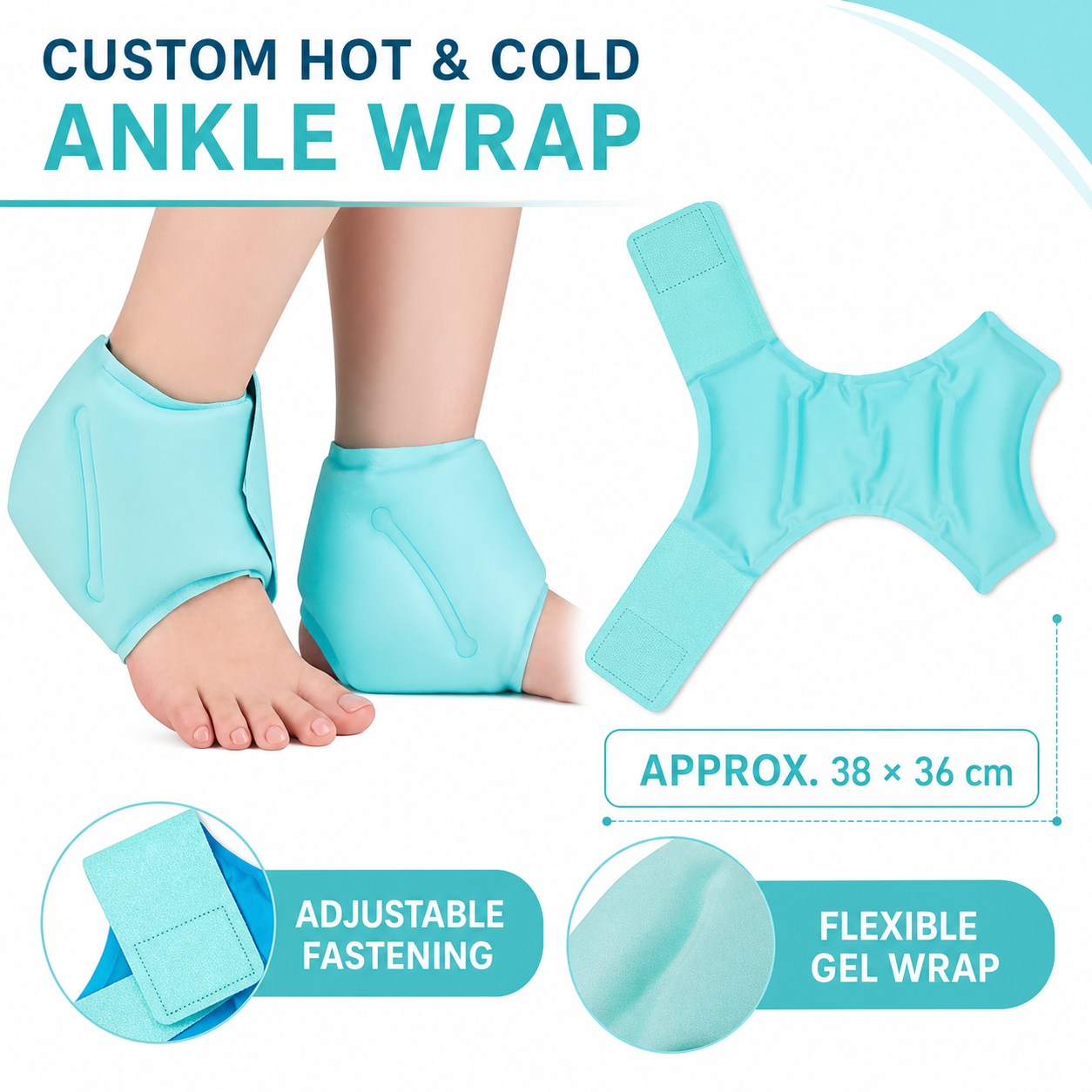
Adjustable Ankle Wraps
Review ankle and upper-foot coverage, strap adjustment and fit across intended users. The RISSE custom ankle ice pack wrap provides an example of a targeted wrap format.
Knee Wraps and Sleeves
Assess sizing, positioning, ease of putting the product on and taking it off, and the effect of product weight on fit. Excessive tightening should not be used to compensate for unsuitable sizing. Review the RISSE knee ice pack wrap sleeve.
Final selection should follow an approved sample, not a product photograph alone.
5. Create a Complete OEM Specification Sheet
A shared specification helps keep the quotation, sample and production order aligned.
| Specification item | Details to confirm |
|---|---|
| Application | Body area, target user and cold-only or dual-use requirements |
| Outer materials | PVC, TPU, EVA, plush, nylon or polyester and the final combination |
| Liquid gel | Target freezing point and sample requirements |
| Dimensions and weight | External dimensions, fill weight, finished weight and agreed tolerances |
| Construction | Compartments, seals, covers, straps and fastenings |
| Branding | Logo, colors, print positions and artwork |
| Packaging | Quantity per set, individual packaging, instructions and cartons |
| Documentation | Material, testing and labeling records required for the target market |
| Acceptance criteria | Appearance, dimensions, sealing, performance and packaging checks |
Confirm the feasibility of customization at the project-review stage. New structures or special requirements should undergo sample evaluation before the final production specification is approved.
6. Sampling and Bulk Production Lead Times
RISSE’s sample lead time is 7 working days, and bulk production lead time is 20 working days.
At project or order confirmation, agree on the starting conditions for these lead times, the time needed for customer sample and artwork approval, the impact of revisions or resampling, and shipping arrangements after production.
Plan development, customer approval, manufacturing and transportation as separate stages. Production lead time is not the same as transit time or final arrival time. Complete requirements and clear specifications help both teams work to defined milestones.
7. Review Samples Professionally
Sample approval should cover appearance, construction, performance and documentation—not just whether the logo is correct.
- Materials and workmanship: Check the agreed materials, seal consistency, fabric edges, stitching and fastening points.
- Dimensions and filling: Verify external dimensions, fill weight and finished weight. Assess whether gel distribution affects fit or positioning.
- Condition after cooling: Use agreed equipment temperatures and preparation times. Record gel condition, flexibility and surface-temperature changes.
- Heating suitability: For dual-use development, confirm permitted heating methods and limits for the final construction. Gel filling alone does not establish microwave or hot-water suitability.
- Sealing and repeated use: Evaluate leakage, seal integrity and condition after repeated heating or cooling cycles using an agreed method and acceptance criteria.
- Packaging and instructions: Check product names, material information, preparation methods, warnings and pack quantities against the finished product.
Retain an approved reference sample and written review records to provide a clear basis for production acceptance. Follow the supplied preparation instructions during evaluation; do not improvise heating methods.
8. Compare Supplier Quotations on Equal Terms
Similar product photographs do not make two quotations equivalent. Different materials, gel formulations, fill weights or packaging can represent different purchasing proposals.
Before comparing prices for wholesale hot and cold packs, align the outer material specification, gel freezing point, dimensions, fill weight, covers, straps, accessories, printing, packaging, order quantity and quantity per set. Also clarify sample, tooling and testing charges, inspection requirements and shipping terms.
Look beyond unit price to sample-to-production consistency, specification traceability and the supplier’s understanding of the technical brief.
Frequently Asked Questions
Which outer materials does RISSE offer?
Options include PVC, TPU, EVA, plush fabric, nylon fabric and polyester fabric. Select the construction and material combination according to the intended application and approved sample.
What is inside the packs?
The internal filling is liquid gel, with selectable freezing points from 0°C to −20°C.
Is a lower gel freezing point always better?
No. Match the freezing point to preparation equipment, intended application and desired gel condition. It does not independently establish product quality, cooling duration or safety.
Can a pack with a −20°C gel freezing point touch bare skin?
A gel freezing point is not a safe skin-contact temperature. Follow the instructions for the specific product, use appropriate skin protection and avoid excessive cold or heat exposure.
Can every material and gel combination be used hot and cold?
No. Dual-use suitability must be confirmed for the complete product, including outer materials, sealing construction, gel formulation and preparation method.
How long do sampling and bulk production take?
RISSE’s sample lead time is 7 working days, and bulk production lead time is 20 working days. Confirm starting conditions, customer approval time and shipping arrangements for the project or order.
Start Your Custom Hot and Cold Pack Project with RISSE
Professional development brings materials, liquid gel formulation, dimensions, positioning and packaging together as one product system.
RISSE offers multiple outer material options, liquid gel freezing points from 0°C to −20°C, 7-working-day sampling and 20-working-day bulk production.
Explore the RISSE product range or contact RISSE about custom hot and cold packs. Include your target market, body area, preferred materials, target gel freezing point, dimensions, estimated quantity and packaging requirements so the team can assess your project and prepare a relevant quotation.